
Which PCE subjects should I choose
to achieve the highest possible admission score?
We explain which PCE subjects you should choose if you want to study for a university degree in Spain and how they affect your admission score.
At a glance
- Which subjects you can choose for the UNEDasiss PCE exams
- Why choosing subjects with a weighting of 0.2 is essential
- How your score out of 10 and 14 is calculated
- A real example worked through step by step
- The latest changes to the PCE exams
- Where to get help if you are still unsure
Before choosing: understand your PCE pathway
If you are considering taking the Pruebas de Competencias Específicas (PCE) and would like to study at a Spanish university, choosing the right subjects is essential. Here, we explain which subjects to choose and how they may affect your university admission score.
Before selecting your subjects, you need to understand your PCE pathway. The number of exams you must take as part of the PCE university entrance process depends on three factors:
- The university degree you want to study.
- The Autonomous Community where you intend to study.
- Your educational background as an international student, including whether your education system has an admission agreement with Spain.
If this is new to you, we recommend reading our pages about the structure of the PCE exams and our PCE frequently asked questions first.
Which PCE subjects should I choose?
Here you can find the full list of subjects available for the Pruebas de Competencias Específicas (PCE) offered by UNEDasiss: German, Biology, Technical Drawing, Design, Business Economics, Physics, French, Foundations of Art, Geography, Geology, History of Spain, History of Philosophy, History of Art, English, Italian, Latin, Spanish Language and Literature, Mathematics, Mathematics Applied to Social Sciences, Portuguese and Chemistry.
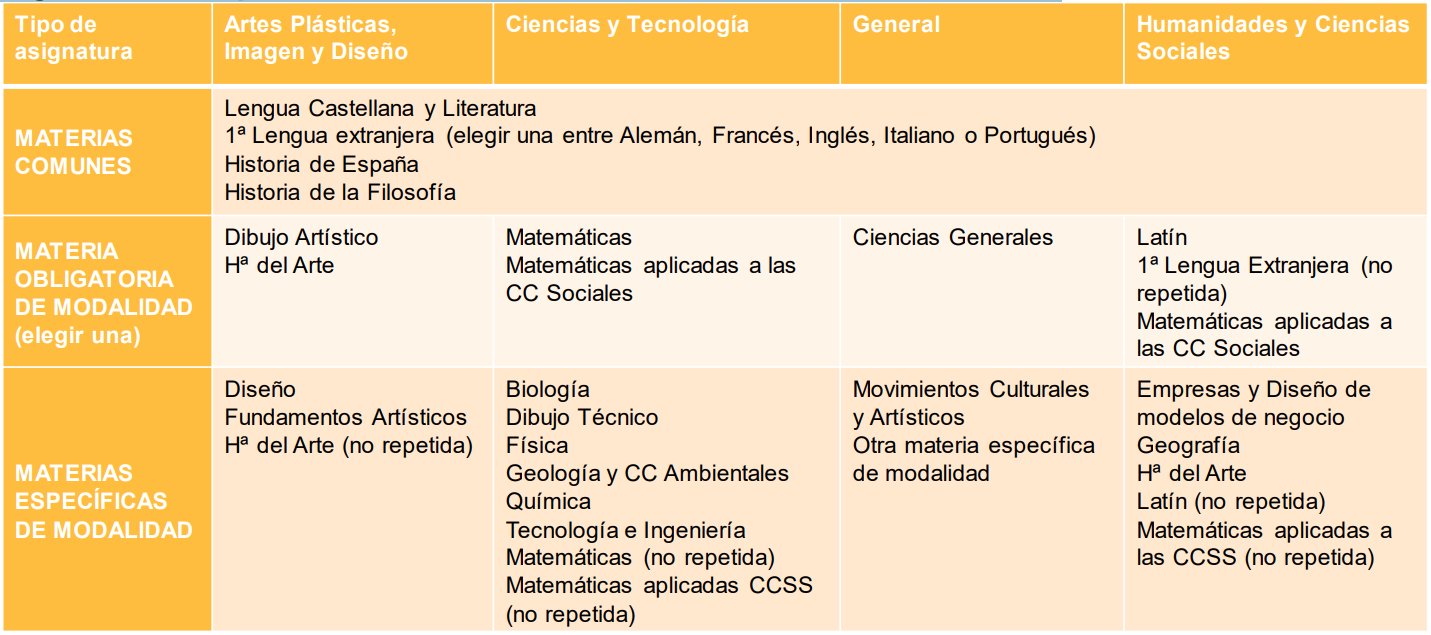
Remember to consider the degree you want to study and check the relevant subject weighting table so that you can choose the subjects that will give you the best possible PCE score.
For more information about the syllabus for each subject, visit the UNEDasiss website, where you will find a detailed breakdown of the content. You can also visit our exam resources page to see worked exam examples in PDF and video format and access useful materials to support your preparation.
Why you should choose subjects with a weighting of 0.2
When choosing which PCE subjects to take, it is essential to know which subjects carry the highest weighting at the university you want to attend, usually 0.2.
Let us look at an example involving a degree that combines different subject areas:
Imagine that you want to study Business Administration at the University of Valencia. The following image shows the subjects and their weightings for two very similar degrees offered by different universities. Please note that the image relates to a previous academic year, so you should always check the current weighting table.
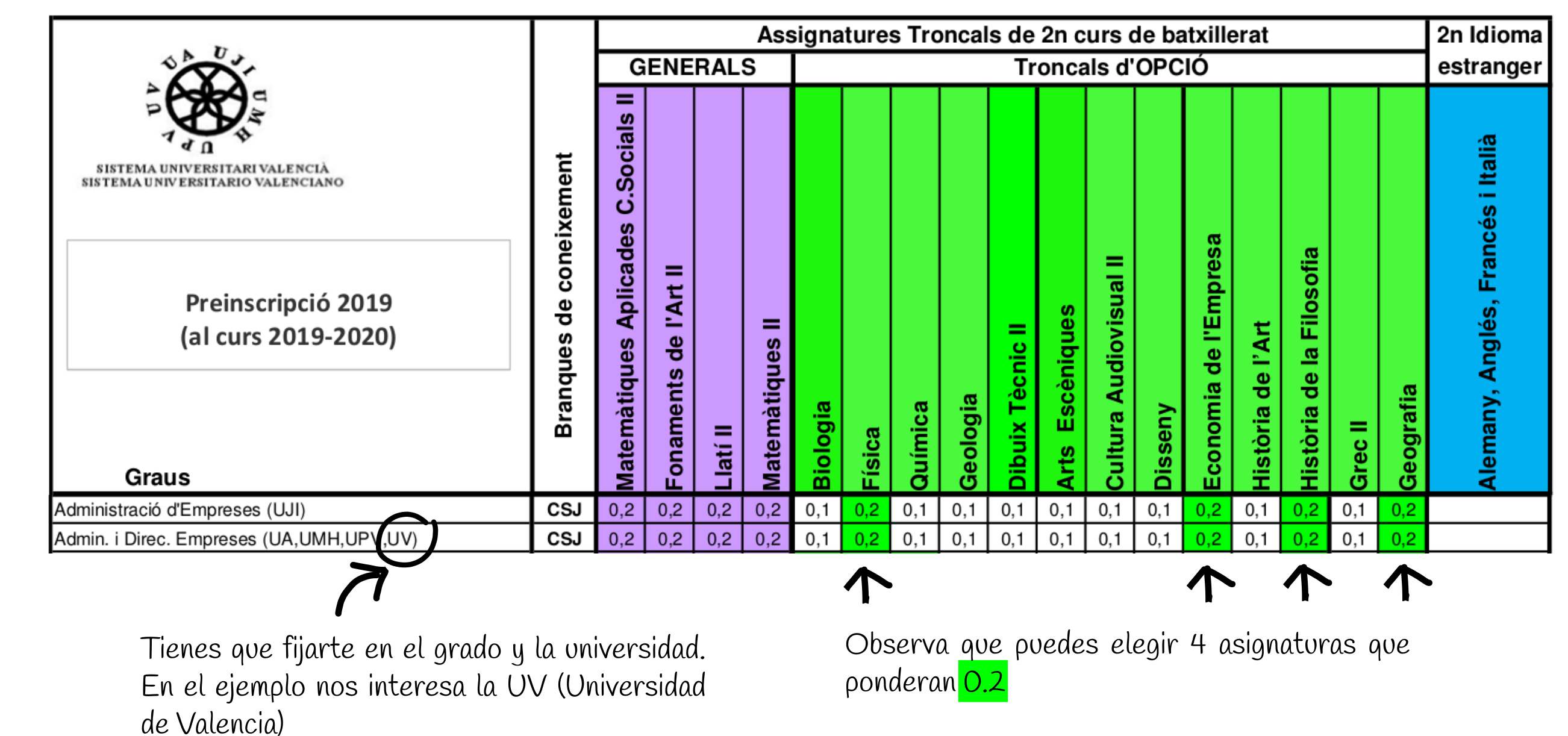
According to this table, at least two of the subjects you choose should carry a weighting of 0.2. Choosing more than two is even better, as it gives you more opportunities to improve your score. At the very least, however, two of your chosen subjects should be marked as 0.2 in the table above.
Does that mean I cannot choose English or another subject?
No. If you plan to study in the Valencian Community, you may choose any subjects you wish, and UNEDasiss will apply a weighting of 0.1 to each one when calculating your score out of 10. The university then calculates the additional points that can take your score from 10 to 14, using only the results from subjects that carry a weighting of 0.2 in its own table.
Bear in mind that your chosen PCE pathway determines how your university admission score is calculated. This article explains the calculation specifically for Valencia. If you intend to study in a city where the flexible PCE pathway is not accepted, we recommend reading our guide to calculating your score for each PCE pathway, which provides detailed information for the different possible cases.
How your university admission score is calculated
Here is a reminder of how your university admission score is calculated in Valencia. The infographic below provides a clear overview.
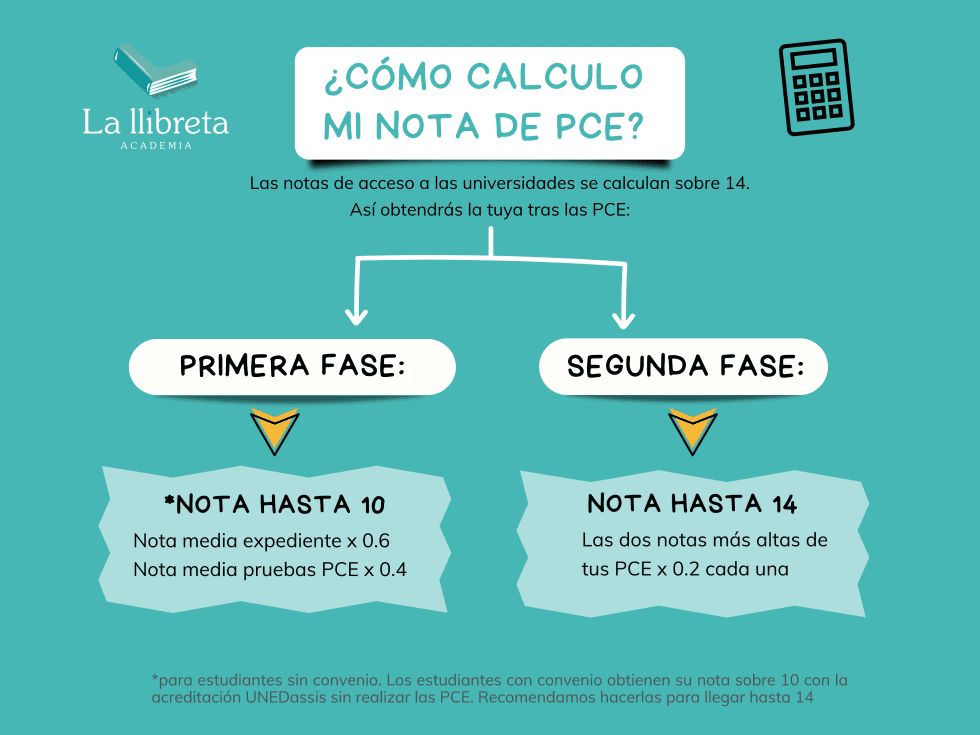
Your score out of 10 is calculated as follows:
- 60% – Your upper secondary school average, once your previous studies have been officially recognised.
- 40% – Your results in the PCE subjects you have taken.
Admission score = (0.2 × NMB + 4) + (0.1 × E1) + (0.1 × E2) + (0.1 × E3) + (0.1 × E4)
NMB = Average upper secondary school grade.
E = Grade obtained in each Prueba de Competencias Específicas (PCE) exam.
Your score out of 14 is calculated as follows:
The two highest-scoring subjects carrying a weighting of 0.2 are selected, and each grade is multiplied by 0.2. The resulting points are then added to your score out of 10.
A step-by-step worked example
For example, a student could take English, History of Philosophy, which carries a weighting of 0.2, Business Economics, which also carries a weighting of 0.2, and Geography, which carries a weighting of 0.2. When UNEDasiss calculates the initial score, each subject contributes with a weighting of 0.1. Together, the four subjects account for 40% of the score added to the student’s upper secondary school grade. Once the combined score has been calculated out of 10, the university selects the two highest grades from the subjects carrying a weighting of 0.2 and adds the corresponding points, producing the final score out of 14.
Imagine that the student receives the following grades out of 10:
- English: 8
- History of Philosophy: 6 — weighting of 0.2
- Business Economics: 9.5 — weighting of 0.2
- Geography: 8.5 — weighting of 0.2
- Average upper secondary school grade: 7
Admission score = (0.2 × 7 + 4) + (0.1 × 8) + (0.1 × 6) + (0.1 × 9.5) + (0.1 × 8.5) = 8.6/10
Highest 0.2 weightings, from Business Economics and Geography: 9.5 × 0.2 + 8.5 × 0.2 = 3.6/4
Final admission score for Business Administration: 8.6 + 3.6 = 12.20/14
Latest PCE changes
One important change introduced under the new LOMLOE framework is that students taking the PCE EBAU pathway may now choose between History of Spain and History of Philosophy. According to annual PCE performance statistics, History of Philosophy has historically produced stronger results, so it may be the more advantageous option. You can view the results here.
There is also an important change for students preparing for science and technology degrees. For the core pathway subject, students may now choose between Mathematics II and Mathematics Applied to Social Sciences. Statistical data suggests that students tend to achieve better results in Mathematics Applied to Social Sciences. Therefore, when both subjects carry the same weighting of 0.2, choosing Mathematics Applied to Social Sciences may be advisable. However, when only Mathematics II carries the required weighting, you should assess your individual circumstances. Students with strong mathematical ability may still benefit from choosing Mathematics II to maximise their score alongside the other two specialist subjects they select.
Still have questions?
Do not worry — we will be happy to help. Contact us!
Structure of the PCE exams
Discover how the PCE requirements vary according to your degree, province and previous education.
Find out more →PCE FAQs
Have questions? Our selection of frequently asked questions is here to help.
Find out more →UNEDasiss subject list
View the complete range of subjects available for the PCE exams.
Find out more →Subject weighting tables
Check the latest subject weightings for all Spanish public universities.
Find out more →You may also be interested in
PAU exam papers for 2025 and 2026
Up-to-date papers for each Autonomous Community, with official examples and competency-based questions.
PAUPAU 2026 rules in the Valencian Community: permitted materials, labels and grades
Rules, permitted materials, penalties and practical advice to help you approach the exam confidently.
Entry requirementsUniversity entry grades in the Valencian Community for 2025–2026
Search university entry grades in Valencia, Alicante and Castellón using your admission score out of 14.
PCEComplete PCE 2026 guide: rules, permitted materials and advice
Official rules, multiple-choice answer sheets and what to do after the exams.
ChemistryPolymers in PAU and PCE exams
Addition and condensation polymers, different types, examples and common exam pitfalls.
BiologyHow to write effective definitions in Biology
Reliable techniques to help you avoid going blank when writing definitions in the exam.
PodcastBiology Podcast — Episode 8: The cell cycle
Organelles and transport across cell membranes, presented by our teaching team.
ChemistrySolutions and dilutions
What concentration means, what changes, what remains constant and why these questions do not have to be difficult.
PodcastBiology Podcast — Episode 7: The plasma membrane
Cellular transport and organelles, presented by our brilliant teaching team.
MathematicsHow to solve competency-based problems in the 2026 university entrance exams
We break down a real exam question and explain the reasoning needed to move from the wording to the solution.
Available PCE courses
Choose the course format that best suits your preparation: online, year-long, intensive, with Spanish support or express.
Online PCE materials
Purchase our self-paced courses and study whenever you like, at your own pace.
On-demand video materials
Year-long PCE course
Classes from October to May, giving you plenty of time and structure to prepare for the exams.
Face-to-face and/or online
Intensive PCE course
Classes from January to May, helping you prepare for the PCE exams in less time.
Face-to-face and/or online
Spanish + PCE
Join the year-long PCE course directly with a minimum A2 level while improving your Spanish alongside your exam preparation.
Face-to-face and/or online
Express PCE course
A focused course held two weeks before the exams, designed to help you revise and consolidate the key content.
Face-to-face and/or online
good afternoon,
my name is Kenzy I wanted to ask if I can still register for this year in the academy. I have a spanish level lower that b1 so i need to take a Spanish course beside the pce course. I also wanted to ask if i could take the pce in english. for the total score calculations if got a gpa 4 out of 4 what number should i put in the academic transcript score.
Good morning,
We are going to send you a personal email with all the answers to your questions to start our Spanish + PCE course.
Kind regards
Good afternoon,
Can I still sign up for the course in Biology and Math? I am an international student looking for the January/May session. I would like to speak more on that with someone of your colleagues. Feel free to drop me a line on my email gerganaml03@gmail.com.
Kind regards,
Gergana.
Hi, I’m applying for an university in Barcelona, so I’ll need to choose 6 subjects. Are all of the 6 subjects going to be valued as 0.1 or only four of them, just like in the example you wrote? I’m asking because I want to take an international course and I was thinking to start learning spanish this summer and mostly once in barcelona, so taking the test in spanish language and literature wouldn’t be easy for me. Also is it possible to take the pce in english? I’m going to take the one in Rome.
Hello, I recommend that you read this post where the structure of the PCE exams is explained, depending on where you want to study: https://academialallibreta.es/structure-of-pce-by-city-and-university-degree/?lang=en. Keep in mind that if you study in Barcelona, you will be required to choose Spanish language and literature, and as you correctly mentioned, it is a challenging subject for students who are not native Spanish speakers. I would suggest considering other cities in Spain to study the degree you desire since the structure is more flexible, like the voluntary PCE, free PCE, or PCE for Baccalaureate mode. In these pathways, you need to study between 2 and 4 subjects and can avoid studying Spanish language. We offer specific Spanish and PCE courses if you are interested in training with us.
Hello, if I need to take 4 subjects for medicine in Madrid (Maths 2, Chemistry, Biology, and Physics) which are weighted, can I also take a 5th PCE English exam even though it is not on the table for medicine? Will it affect my grade positively or would it not change my grade at all if I get a high score for it? Are only 4 subjects allowed for universities in Madrid?
Hi, Abigel, it depends. If your country has a reciprocity agreement, you can only take the subjects that are weighted 0,2 to increase your grade up to 14, it is not necessary for you to take English as it doesn’t affect your grade at all. If your country doesn’t have a reciprocity agreement, then you must take English and Maths II and then choose 2 subjects between Chemistry, Biology and Physic. We recommend Biology and Chemistry.