
Structure of the PCE exams
by city and university degree
Find the right PCE pathway based on where you completed your upper secondary education and the city where you plan to study your university degree.
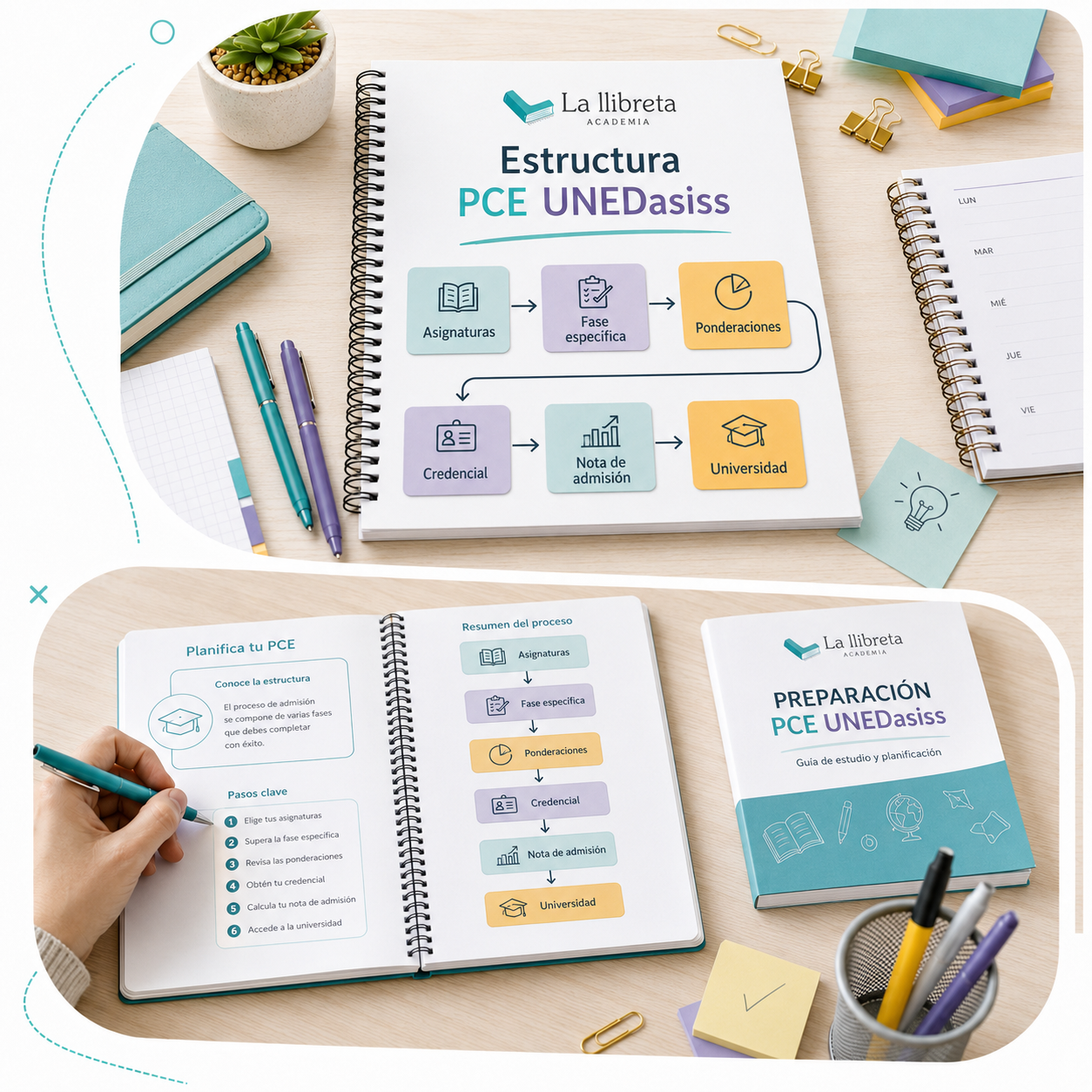
At a glance
- The three factors that determine which subjects you need to take
- The four PCE pathways and who each one is intended for
- How many subjects you need to take in your particular case
- Subject lists organised by field of study
- A glossary of key terms, including weightings, agreements and scores
- Real examples answered in the comments
The three key factors
If you have completed upper secondary education outside Spain and want to study at a Spanish university, the first thing you need to know is that, in most cases, you will have to take the PCE exams (Pruebas de Competencias Específicas). These exams play an essential role in the university admission process.
The second important point is that the PCE subjects you need to take depend on three main factors:
- Your educational background, including whether you studied within the European Union, completed the International Baccalaureate (IB), or come from a country with a university admission agreement with Spain.
- The Spanish province where you plan to study, as the requirements may vary between Autonomous Communities.
- The university degree you want to study, as each degree has certain subjects that carry a higher weighting.
The four PCE pathways
Here is how they work:
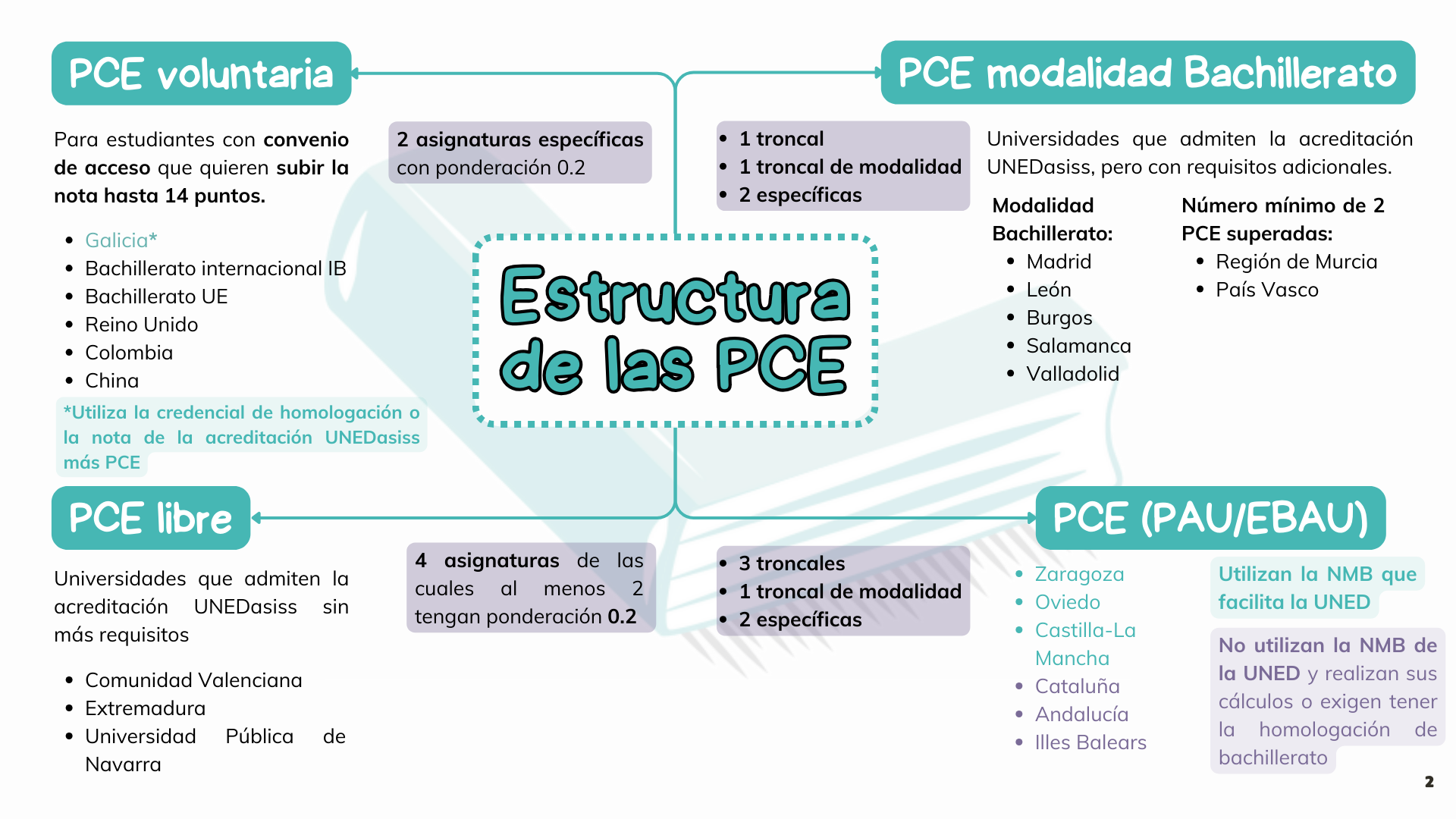
This infographic shows the four main PCE pathways, each designed for a different situation and set of objectives:
- The Voluntary PCE pathway
- The PCE Bachillerato pathway
- The Flexible PCE pathway
- The PCE PAU/EBAU pathway
Each pathway has a different number of subjects and its own specific requirements:
- For the Voluntary PCE pathway, you only need to take two specialist subjects.
- For the PCE Bachillerato pathway and the Flexible PCE pathway, you need to take four subjects. The Bachillerato pathway also has specific requirements regarding core and pathway subjects.
- For the PCE PAU/EBAU pathway, you generally need to take six subjects, following the traditional university entrance structure used in certain Autonomous Communities.
It is important to note that the exam for each subject is the same across all pathways. For example, if you choose Biology, the exam content will be identical. What changes is the number of subjects you need to take and whether your pathway requires particular subjects.
Use the infographic to identify the pathway that best suits your situation.
What does each PCE pathway involve?
Below, we explain each of the four main PCE pathways in detail. Understanding the features and specific requirements of each route is essential when planning your admission to a Spanish university and choosing the option that best suits your educational background and academic goals.
Voluntary PCE pathway
The Voluntary PCE pathway means that you do not have to take UNED exams when your upper secondary school grade, calculated out of 10, is already high enough for the university course you want to study. However, for highly competitive degrees, where the entry grade is often above 10, you will need to take additional exams to increase your admission score to a maximum of 14 points. You do this by voluntarily taking several specialist subjects. The university will apply the relevant weighting to your two highest grades, according to the weighting coefficients established for your chosen degree.
Who is the Voluntary PCE pathway intended for?
You can follow the VOLUNTARY PCE PATHWAY if you plan to study a university degree in Galicia, completed your upper secondary education within the European Union, hold an International Baccalaureate (IB), or come from a country with a university admission agreement with Spain, such as the United Kingdom, Colombia or China.
Students who have completed a European secondary school qualification or the International Baccalaureate (IB) may be able to apply for subject recognition. This means that some subjects you have already studied may be officially recognised and count directly towards your admission score out of 14. This can reduce the number of PCE subjects you need to take or allow you to focus on the subjects in which you are most likely to achieve the highest grades.
If you are unfamiliar with this process or unsure how to apply, do not worry. We have prepared a complete guide explaining step by step how subject recognition works, the requirements you need to meet and how this option can help you improve your chances of university admission.
📌 Read the full article here and find the answers to all your questions =).
PCE Bachillerato pathway
You need to take four subjects:
- One core subject, chosen from History of Spain or History of Philosophy, Spanish Language and Literature, or a foreign language. We recommend choosing English if you already have a good command of the language.
- One core pathway subject, depending on the Bachillerato pathway you need to certify: Artistic Drawing, Mathematics, Mathematics Applied to Social Sciences, General Sciences or Latin.
- Two specialist subjects. You should choose the two subjects with the highest weighting for your intended degree.
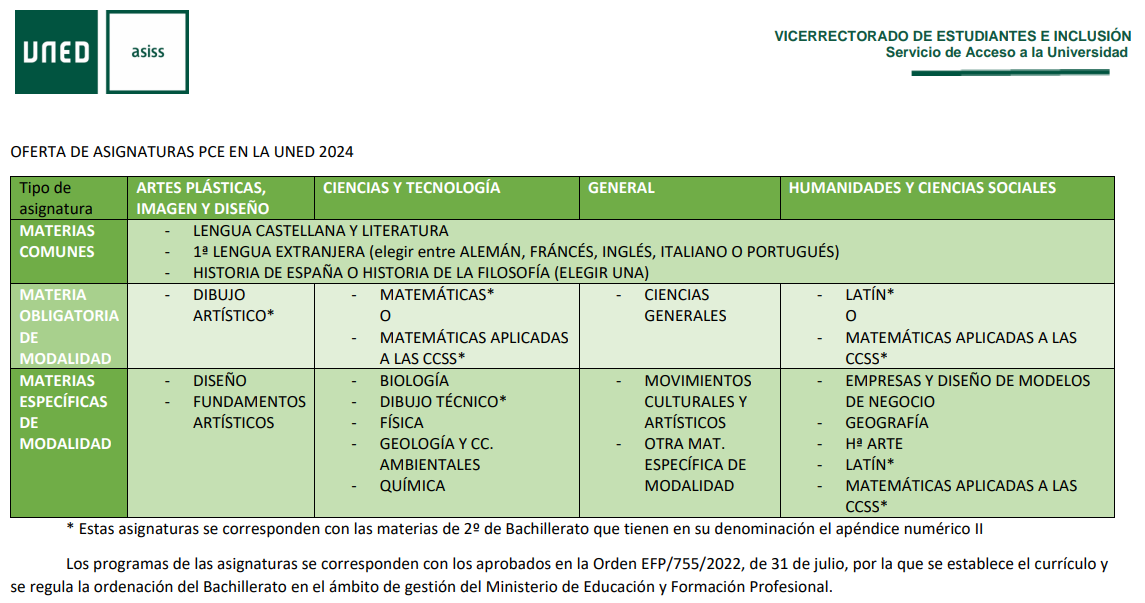
The table further down the page shows the subjects available for each field of study.
Who is the PCE Bachillerato pathway intended for?
You will need to follow the PCE Bachillerato pathway if you plan to study a university degree in any of the following Autonomous Communities:
- Community of Madrid
- Castile and León
- Region of Murcia
- Basque Country
You must meet a series of specific requirements to certify the relevant Bachillerato pathway.
Requirements for the Bachillerato pathway:
- Number of exams: You may take a maximum of six subjects. To certify a Bachillerato pathway, you must choose at least one subject from each required group, depending on your selected pathway.
- Ways to certify the pathway: There are two options for meeting the requirements:
- Option 1: Pass three subjects with a minimum grade of 5 out of 10, choosing at least one subject from each required group for your selected pathway.
- Option 2: Achieve an average grade of 5 across four PCE subjects, including at least one subject from each required group for your selected pathway.
- Exception for Murcia and the Basque Country: In these Autonomous Communities, you only need to pass two PCE subjects to meet the requirements.
Flexible PCE pathway
To achieve the highest possible score, you need to take four subjects. The structure is flexible, which means that you do not have to choose a core subject or a core pathway subject. You only need to consider which subjects carry the highest weighting for your intended university degree. We generally recommend choosing at least two or three subjects with a weighting of 0.2.
You can find more information in this article.
Who is the Flexible PCE pathway intended for?
You will need to follow the FLEXIBLE PCE PATHWAY if you plan to study a university degree in:
- Valencian Community
- Extremadura
- Public University of Navarre
PCE PAU/EBAU pathway
The PAU/EBAU structure means that you must take at least four subjects, although students generally take six in order to obtain the additional weighted points required by the university:
- Three core subjects: History of Spain or History of Philosophy, Spanish Language and Literature, and a foreign language, usually English or French.
- One core pathway subject: Artistic Drawing, Mathematics, Mathematics Applied to Social Sciences, General Sciences or Latin.
- Two additional specialist subjects to reach the maximum university admission score of 14 points. As with the other pathways, you should select the two specialist subjects with the highest weighting.
Who is the PCE PAU/EBAU pathway intended for?
You will need to follow the PCE PAU/EBAU pathway if you plan to study a university degree in:
- Zaragoza
- Oviedo
- Castile-La Mancha
- Catalonia
- Andalusia
- Balearic Islands
*These universities use the NMB provided by UNED
*These universities do not use the NMB provided by UNED and either perform their own calculations or require official recognition of the student’s upper secondary qualification
PCE subject list by field of study
Glossary of PCE terms
What are subject weightings?
Subject weightings are the values universities assign to each subject according to its relevance to the degree you want to study. Each university determines its own weightings, which vary depending on the degree.
To find out which subjects carry the highest weighting and how they affect your application, you need to check the weighting tables published by each university. You should also review the degree’s entry grade to understand the minimum score you are likely to need.
In this article, you can consult the weighting tables for all Spanish public universities, which we update every year. They will help you understand which subjects are most useful for improving your admission score.
For a specific example, read this article about subject weightings in the Valencian Community, where we explain how the system works in that region.
University admission agreement
As shown in the table above, students who completed their upper secondary education in a country with an admission agreement recognised by UNED can have their grade converted into a Spanish score, up to a maximum of 10 points. They can then increase their score to 14, the maximum used by Spanish universities, by taking two Pruebas de Competencias Específicas and choosing the subjects with the highest weighting for their intended degree.
Students whose education system does not have an admission agreement must take the PCE exams, usually sitting between four and six subjects, depending on the pathway they need to follow.
If you are unsure whether your country has an admission agreement, this article explains how to check.
University access score
Your university access score is the weighted average of your final upper secondary school or officially recognised qualification grade, which accounts for 60%, and your PCE exam results, which account for 40%. The precise formula may vary according to your pathway. If you are unsure how this score is calculated, we recommend reading this explanatory article and using our grade calculators.
The university access score has a maximum of 10 points and is the basic score used to apply to Spanish universities. However, for high-demand degrees, where competition is greater, the minimum required score is usually higher. It is therefore essential to take specialist subjects that can increase your final score to the maximum of 14 points used for admission to these degrees.
Admission score
Your admission score is the final score used to compete for a place at university. It includes your university access score, worth up to 10 points, plus the additional points obtained through the voluntary PCE subjects, worth up to four further points. These additional points are calculated by applying the relevant weighting to the specialist subjects for your chosen degree and university. The maximum admission score is 14 points.
This score is particularly important for highly competitive degrees with very high entry grades, where a stronger admission score improves your chances of securing a place.
Entry grade
The entry grade is the lowest admission score achieved by a student who secured a place on a particular degree during the previous academic year. It changes each year and depends on the number of available places, the level of demand for the degree and the applicants’ grades. It is a useful reference, but it does not guarantee admission, as it may rise or fall depending on the number of applicants and their results. In our article about university entry grades, we explain what they are, how they are determined and how you can improve your chances of exceeding them.
You may also be interested in
PAU exam papers for 2025 and 2026
Explore all the papers for the new university entrance exams, organised by Autonomous Community, with official examples and competency-based questions.
PAUPAU 2026 rules in the Valencian Community: permitted materials, labels and grades
Rules, permitted materials, penalties, publication of grades and practical advice to help you approach the exam confidently.
Entry gradesUniversity entry grades in the Valencian Community for 2025–2026
Search university entry grades in the Valencian Community and explore degrees in Valencia, Alicante and Castellón using your admission score out of 14.
PCEComplete PCE 2026 guide: rules, permitted materials and advice
Official rules, permitted materials, multiple-choice answer sheets and what to do after the exams, so you can approach the PCE with confidence.
ChemistryPolymers in PAU and PCE exams
A quick Chemistry guide covering addition and condensation polymers, different types, examples and common exam pitfalls.
BiologyHow to write effective definitions in Biology
Reliable techniques to help you avoid going blank when writing definitions in the exam, with interactive exercises for practice.
Available PCE courses
Choose the course format that best suits your preparation: online, year-long, intensive, with Spanish support or express.
Online PCE materials
Purchase our self-paced courses and study whenever you like, at your own pace.
On-demand video materials
Year-long PCE course
Classes from October to May, giving you plenty of time and structure to prepare for the exams.
Face-to-face and/or online
Intensive PCE course
Classes from January to May, helping you prepare for the PCE exams in less time.
Face-to-face and/or online
Spanish + PCE
Join the year-long PCE course directly with a minimum A2 level while improving your Spanish alongside your exam preparation.
Face-to-face and/or online
Express PCE course
A focused course held two weeks before the exams, designed to help you revise and consolidate the key content.
Face-to-face and/or online

Hello!
I’m trying to choose subjects for the PCE, could you tell me if I understand the weighing system correctly, if that’s alright? I want to enroll in the University of Salamanca next year, to study Psychology (bachelor degree). For that I want to take the English exam (troncal), Mathematics CCSS (troncal de modalidad), History of Philosophy, and Biology. The weightings are: 0,2 for Mathematics, 0,2 for Biology, and 0,1 for Philosophy. Do I understand correctly that in the second stage of the weighing (from 10 to 14) only Mathematics and Biology will be considered, as two subjects with the highest weights? Even if I get better results for Philosophy than for Maths, for example? And it does not matter that Mathematics is one of my core subjects, is that right?
I’m not sure if you can help me here, but I would be enormously grateful if you could! In any case, thank you for your time.
Hi! To calculate your final score for the University of Salamanca, they will consider Philosophy and Biology because those are the specific subjects you have chosen. Since Mathematics CCSS is part of your base score out of 10, it may be more advantageous to choose Mathematics II or further focus on Biology to maximize your weighted score. Good luck, and best regards!
Thank you for your answer! Just to be clear: so, for example, I can take English, Biology, Mathematics CCSS and Mathematics 2 (instead of Philosophy)? I thought that I could choose only one type of Mathematics, since they probably overlap in some topics.
Hi,
I want to study an undergraduate degree in digital art in Spain, and I am considered an international student.
I was wondering if I should take the PCE exam?
Thank you
Hi Diana, it depends on where you studied and in which city you would like to study your Degree. Feel free to reach out to us at secretaria@academialallibreta.es and tell us your specific case so we can help you giving the information you need.
Hello I have given my pce examination and have performed well my subjects were biology , chemistry, general science and English I’m aiming for the course of medicine . I have taken general science as my core subject and it is added newly to the system will I be awarded marks by 0.2 like other core subjects like maths 1 or maths 2 . I’m aiming for the universities of Valencia and madrid
Hello, the subject General Science doesn’t weight 0,2 for Medicine. The subjects that weight 0,2 for Medicine in Valencia and Madrid will be Biology and Chemistry. Good luck! 🙂
Hello there! I am planning to apply to the University of Valencia to study Business Management starting September 2025. I was wondering when the deadline is to apply for the PCE and apply for the university as well. It doesn’t say anywhere in UNEDasiss or the uni website.
Hi, Celia! The registration dates for the exams haven’t been set yet. Normally, the registration period for the PCE is between February and April. As for universities, their application windows are typically open from late June to early July, but those dates haven’t been confirmed either. Regards,